
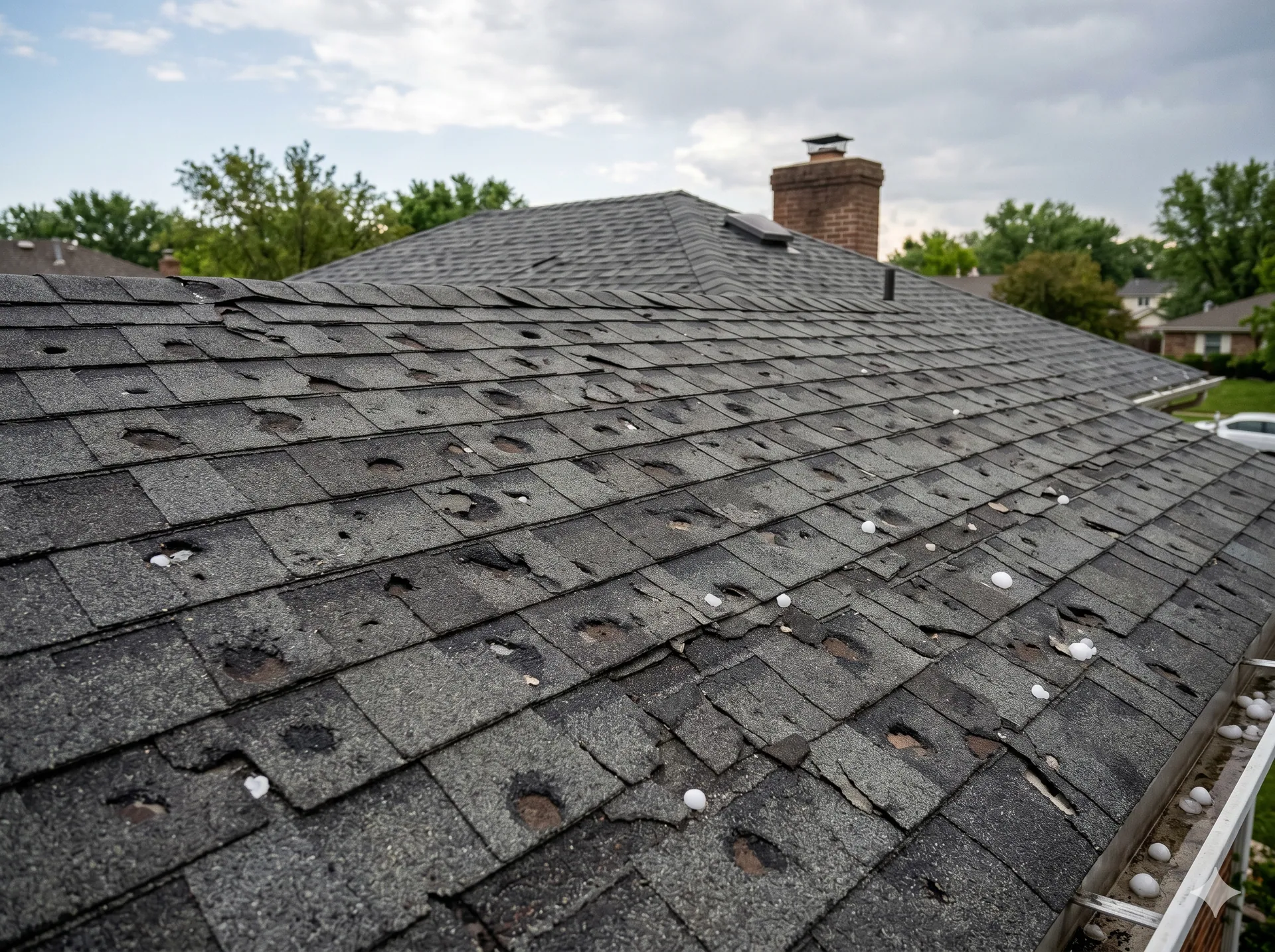
The first 24 hours after the storm
The first day after a hail or wind event sets the trajectory of the whole claim. Two things matter most: stop the bleeding, and start the paper trail. If the roof is leaking, tarp the active intrusion or call someone who can — water that runs into the wall cavity for 48 hours becomes mold remediation on top of roof repair, and most carriers will not pay for damage they decide was caused by your delay.
Photograph everything before anyone touches it. Wide elevation shots from the ground, close-ups of any visible hail bruising or torn shingles, the gutters (back-channel dings show up on metal), screen frames, fence panels, the AC condenser top fins, and anything sitting in the yard. Note the date and the storm event. Then call your carrier and open the claim. In Texas the policy deadline is generally one year from the date of loss (Tex. Ins. Code §16.005); in Ohio most policies contractually limit suit to one year and require prompt notice. File first, sort the scope later.
What not to do: do not sign anything a door-to-door canvasser hands you, do not accept the first carrier offer without an independent inspection, and do not let a contractor offer to "waive" your deductible — that is a felony in Texas under Tex. Ins. Code §707.003 and a fast way to lose the claim entirely. If a roof is actively leaking and the situation is an emergency, the right call is the right kind of help — see storm damage repair for what an emergency tarp-and-stabilize visit actually looks like.
What insurance actually covers — and what gets missed
Most Texas and Ohio homeowner policies cover wind, hail, fire, falling objects, and tornadoes. They do not cover flood (separate NFIP policy required), normal wear, or damage attributable to deferred maintenance. That part is usually fine. The harder problem is what carriers leave out of the scope of a covered claim.
An adjuster gets thirty to sixty minutes on a roof. They walk the front and the largest accessible elevation, they spot-check shingle granule loss, and they write what they can see from the slope they are standing on. The damage they routinely miss is the damage that is not on the front slope:
- Decking under multi-layer shingle systems — rotted OSB or sheathing only visible after tear-off
- Kickout flashing at roof-to-wall transitions — the single most common cause of trim and stucco rot we find
- Back-elevation siding hits and back-channel gutter dings (the storm hits the back of the house too)
- Pipe boots and lead jacks split by hail and aging UV exposure
- Step-flashing that has separated from sidewall and is no longer keeping water out
- Soft-metal verification points — gutters, vents, AC fins — that confirm hail size and impact
- Screen frames, garage doors, and condenser tops, all of which corroborate event severity
These are not edge cases. They show up on a meaningful fraction of every claim once a contractor with diagnostic depth walks the elevations alongside the adjuster. The question is whether they get documented at the inspection or after the homeowner has already signed the carrier’s scope. The answer to that question is what separates a fully-paid claim from a partially-paid one. The full leak-diagnostic protocol — moisture meter, soft-metal test points, attic inspection, drone imagery — is what catches them while it still matters.
Texas: rate-protection, deductibles, and the matching argument
Texas is the densest hail-claim market in the country, and the regulatory regime around homeowner claims reflects that. Three rules every Texas homeowner should know going in:
Rate-protection. Texas insurers cannot raise your premium or refuse to renew because you filed a weather claim. This is the most underused homeowner protection on the books. If a neighbor or a canvasser tells you a claim "ruins your premium," that is wrong on a TX-policy roof.
Deductibles. Texas wind-and-hail deductibles are increasingly percentage-based — 1% or 2% of your dwelling-coverage amount, not a flat dollar figure. On a $400,000 dwelling that is $4,000–$8,000 out of pocket before the carrier pays a dollar. Know your number before the storm hits.
Matching. Texas does not have a state matching law. Replacement of an undamaged elevation to match a damaged one is argued under the policy’s "like kind and quality" language, on a case-by-case basis. It is winnable when the documentation is right; it is rarely volunteered. The contractor’s job is to make the line-of-sight argument with photos. See our coverage map for the regional corridor we cover and the carrier mix we see most often.
Ohio: matching law, response timelines, ACV pressure
Ohio operates under a different regulatory backstop, and on one specific point it works strongly in the homeowner’s favor. Ohio Administrative Code 3901-1-54(I) is one of the strongest matching rules in the country: it requires insurers to replace as much of a damaged item — siding, paint, mortar, shingles — as needed to achieve "reasonably comparable appearance." In practice it routinely drives full-elevation replacements that would never be ordered in a state without a matching rule.
Ohio also enforces tighter response timelines than most states. Carriers have fifteen days to acknowledge a claim and twenty-one days to make a coverage decision after they receive a complete proof of loss. Slow-walking a homeowner past those windows is grounds for an Ohio Department of Insurance complaint.
The headwind in Ohio is on older roofs. Carriers are aggressively moving older roofs to ACV (actual cash value) rather than RCV (replacement cost value), and several are pushing percentage-based wind/hail deductibles into renewals. Cosmetic-damage exclusions are also creeping into Ohio policies. Read the renewal carefully every year. Toggle to Ohio on our coverage map for the NE Ohio cities we cover — Cleveland, Solon, and Chagrin Falls.
Speaking the carrier's language — and why it matters
The property-insurance industry runs on industry-standard scoping software. Every adjuster you will ever meet writes their estimate in that same software, on the carrier’s regional price list, on a specific effective price date. If your contractor is handing the carrier a hand-typed estimate or a photocopy of a yellow notepad, the carrier’s desk reviewer is going to set it aside and ask for a "real" estimate. That is the polite version. The unpolite version is that the claim slows down for weeks while the format gets re-litigated.
The operating numbers
behind carrier-grade documentation
The practical effect of writing a line-itemized scope of repair in the carrier’s native software is simple. Your scope and your prices are in the carrier’s native language. The desk reviewer can drop your estimate next to the adjuster’s estimate and compare line-by-line. Disagreements collapse to specific line items, which can be re-photographed and re-justified, instead of a vague back-and-forth about whether your number is "reasonable." Faster decisions, fewer re-inspections, fewer denials over format.
Supplements: the workhorse of a fully-paid claim
Almost every meaningful claim involves a supplement. Here is why: an adjuster writes a scope from what they can see standing on a slope. The contractor tears off the old roof, finds rotted decking the adjuster could not see, photographs it the moment of discovery, writes the supplement as a line-itemized scope of repair, and submits it under the existing claim number. The carrier reviews the supplemental documentation and pays the additional scope.
Three things matter about supplements. First: there is no new deductible. The supplement is an addition to the original claim, not a separate claim. Second: photographic evidence taken at the moment of discovery is non-negotiable. A supplement written from memory after the truck has left the jobsite will not survive review. Third: the dollar values are real. Industry data on storm-restoration claims suggests supplements recover an average of $7,000–$8,000 per claim. That is not contractor folklore — that is the difference between a roof that looks acceptable and a roof that is structurally finished the way the policy entitled the homeowner to.
Five questions to ask a contractor before you sign
A storm hits, a flier shows up on the door, and a homeowner is asked to sign before they have time to think. The five questions below filter most of the noise:
- Do you write your estimates in the same software the adjuster uses, on my carrier’s regional price list and effective price date? (The right answer is yes.)
- Will you attend the adjuster meeting on-site and walk the elevations together? (The right answer is yes.)
- How do you document hidden damage at tear-off? (The right answer is photos at the moment of discovery, supplemented under the existing claim number.)
- Will you waive my deductible? (The right answer is no — it is illegal in Texas and a regulatory red flag everywhere else.)
- Are you the contractor doing the work, or are you a public adjuster? (Texas prohibits the same person from doing both on the same claim. Make sure you understand which role you are hiring.)
When to escalate
If the carrier will not pay a documented scope, the homeowner has tools. Re-inspection requests are the cheapest. Appraisal-clause invocation is the next step — most policies require both sides to pick an appraiser, who jointly pick an umpire, and the resulting decision binds both parties. Beyond that: regulatory complaints. The Texas Department of Insurance complaint line is 1-800-252-3439. The Ohio Department of Insurance complaint line is 1-800-686-1526. Litigation is the last resort and should be paired with an insurance-coverage attorney who specializes in first-party claims.
The clock matters. In Texas, Tex. Ins. Code §16.005 sets a statutory minimum of one year from the date of loss to file suit, and most policies match that. In Ohio, most policies contractually limit suit to one year. Keep the paper trail dated and the claim number on every email.
What good looks like
A properly documented claim has nine specific artifacts: drone photographs of every elevation, an attic inspection with moisture readings, soft-metal test points (gutters, vents, AC fins) that confirm hail size, neighborhood comparable photos that show the storm hit at scale, NOAA hail-size confirmation pulled from the public storm reports for the date of loss, a line-itemized scope of repair written on the carrier’s regional price list, photos taken at the moment any hidden damage is discovered, supplements filed under the original claim number, and a single point of contact at the contractor through final payment.
That is the documentation discipline RA brings to every claim — Texas or Ohio. If your roof took a storm hit and you are not sure whether the carrier’s scope reflects the full damage, get a second set of eyes on it before the claim closes.
Free roof inspection — drone photos, attic check, soft-metal verification, and a line-itemized scope of repair if a claim is warranted. No upfront cost.