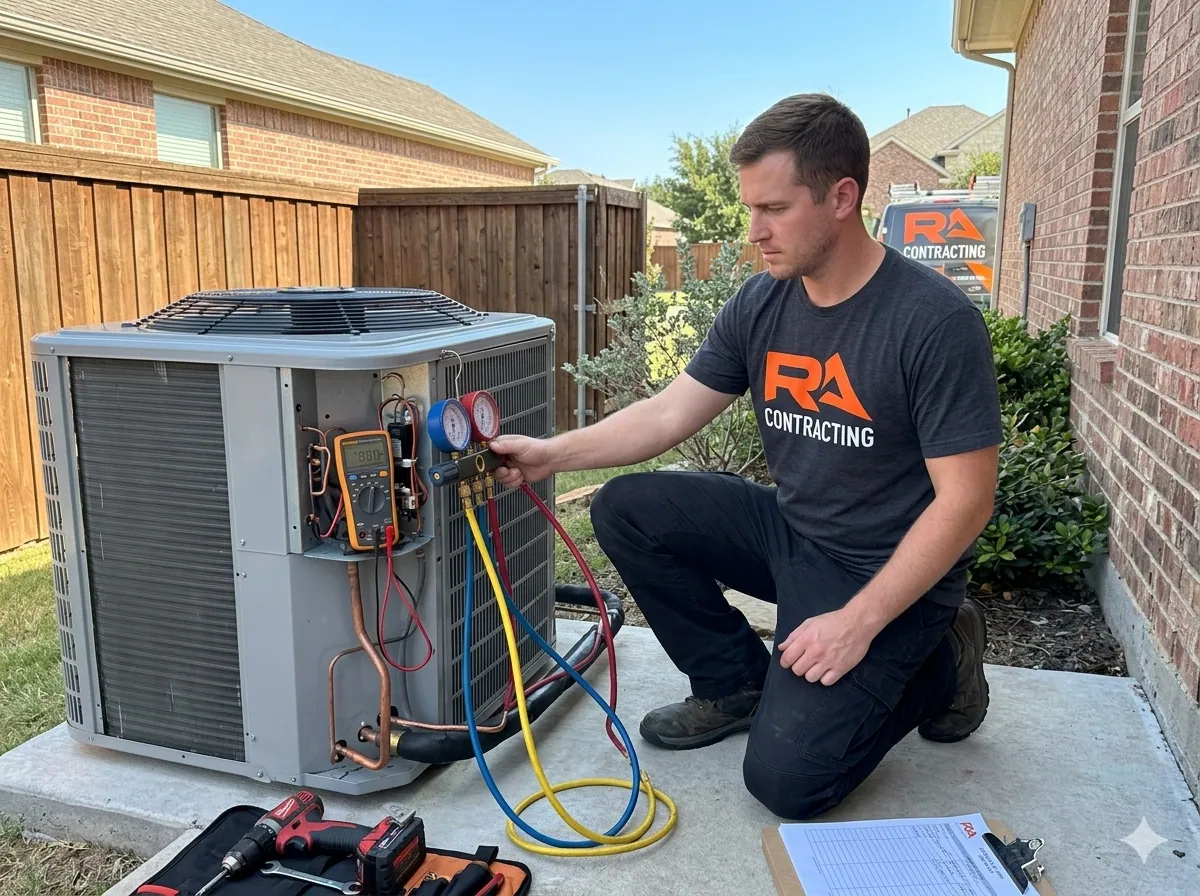
§ 02.02AC install — Texas + Ohio

Sized off Manual J. Not off square footage.

A real room-by-room load calc on each install — about ninety minutes on site. We won't oversize a system because the catalog says to. The cheap fix is sometimes the right fix; we will tell you which way the math points before any new unit gets quoted.

How a load calculation actually runs

Square footage is a guess. Manual J is the math.

Every house gets a real load calculation before anything gets quoted. Here is how that hour-and-a-half on site turns into a tonnage answer — and why the same square footage in Akron and Plano does not size the same system.

01

Walk every room.

Tape measure on the floor, not a clipboard estimate. Width, length, ceiling height, exterior wall area, every window orientation, every door to a non-conditioned space.

About 90 minutes on a 1,800-sqft house. Numbers go straight into the load-calc software, not back to the office.

02

Score each surface for heat gain.

A west-facing single-pane window in Texas pulls in seven times the heat of a north-facing LowE window. Manual J multiplies surface area by climate factor by U-value — that is where the BTU subtotals come from.

Same wall area can call for 1.5 tons in Akron and 2.5 tons in Plano. The envelope is the math, not the square footage.

03

Add infiltration, ducts, occupants.

Older houses leak air. Attic ducts pick up extra heat on a 100°F day. Four people throw off about 1,800 BTU/hr just by being home. None of these show up on a square-footage shortcut.

Blower-door test optional but recommended on anything pre-2000.

04

Pick a ton — round down, never up.

Add the subtotals, round to the nearest half-ton on the cooling side. If the answer is 25,350 BTU/hr, the system is 2.5 tons — not 3.0. The slightly undersized cooling runs longer, dehumidifies harder, and lasts.

Heat-pump heating side is sized to the heating load separately, then the larger of the two governs equipment size.

Three to four hours of office work turns into a single tonnage answer per system. We bring that worksheet to the kitchen table — you keep a copy whether you book the install or not.

Refrigerant register

EPA phase-down · in effect since January 1, 2025. Working systems do not need to be ripped out — only new equipment changes.

  • R-22Out of productionMade until 2010, banned new in 2020. Recycled-only repair from here. Replace at next major failure.
  • R-410AService-onlyStill legal to top off, repair, and live with for years. Just not put in new equipment after Jan 1, 2025.
  • R-454BNew standardNow factory-shipped on most new residential AC and heat pumps. About a quarter the climate impact of R-410A.
  • R-32New standardThe other EPA-approved low-impact refrigerant. Same story as R-454B; pick whichever the chosen brand ships.
The equipment side, in spec

Right-sized equipment. Right-sized lineset.

A correctly tonned condenser still loses 8–12% of its rated capacity to a refrigerant lineset that is one pipe-size too small or routed forty extra feet through a hot attic. The boring stuff is where the install actually pays off.

A · Lineset diameterper manufacturer cut sheet
TonnageSuctionLiquidMax run
2.0tons3/4"3/8"50 ft
2.5tons3/4"3/8"50 ft
3.0tons7/8"3/8"50 ft
4.0tons7/8"3/8"40 ft
5.0tons1-1/8"3/8"40 ft
Suction line wrapped in continuous 3/8" closed-cell insulation. No gaps at the wall penetration, the line-set hump, or the condenser fitting — that is where every "sweating lineset" call comes from.
B · Condenser padstandard residential install
  • Pad
    36 × 36 × 3 in.

    Composite or poured concrete pad, level within 1/4" across the diagonal. Set on tamped pea gravel — never on bare soil.

  • Clearances
    24 in. service · 18 in. coil

    Service side gets 24" minimum for tech access. Coil-intake faces (the fin sides) keep 18" clear of fences, shrubs, and AC drips.

  • Elevation
    4 in. above grade

    Pad sits on a 4" gravel/turf shoulder above grade so spring rain runoff and irrigation overspray do not pool around the base.

  • Tie-down
    Hurricane straps · OH coastal

    Required on Texas Gulf coast and any wind-zone install. Two anchored straps to the pad, sealed against pad penetrations.

Day-of commissioning

Eight numbers we hit before walking off the job.

The new equipment is half of an install. The other half is the day-of commissioning sequence — and most "installs" skip half of it. Here is the full ledger we hold ourselves to, with the gauge target on every step.

  1. STEP / 01

    Pressure-test with dry nitrogen.

    Lineset is pressurized with dry nitrogen and held under gauge for fifteen minutes. Any drop = leak. No leaks pass before refrigerant goes in.

    450 psi · 15 min hold
  2. STEP / 02

    Triple evacuation to deep vacuum.

    Two-stage vacuum pump pulls the system down to 500 microns three separate times, then has to hold the reading. This is what gets all the moisture out — moisture is what kills compressors first.

    500 microns · 30 min hold
  3. STEP / 03

    Refrigerant weighed in to factory spec.

    Charge weighed on a digital scale to the manufacturer's data-plate spec, not topped off until the gauges "look right." Subcooling and superheat verified at the equipment after the system stabilizes.

    Within 0.1 lb of data plate
  4. STEP / 04

    Static pressure measured at the plenum.

    Manometer on the supply and return plenums after start-up. Total external static under 0.5 inches of water column = ducts deliver the rated airflow. Over and we hand back the duct fix before walking off the job.

    < 0.5 in. WC total
  5. STEP / 05

    Condensate float-switch verified.

    Trap primed, secondary safety-float switch fired by physically raising the water level — not by jumpering the wire. The system shuts down. We watch it shut down before signing off.

    Bench test · physical fill
  6. STEP / 06

    Thermostat configured and walked.

    Equipment-side stages configured (single, two-stage, variable-speed). On heat-pump installs, the dual-fuel balance point is set to the climate zone — Plano runs at 35°F, Akron at 25°F. We walk the homeowner through the schedule.

    Stages · cycles · balance point
  7. STEP / 07

    Manufacturer warranty registered.

    Equipment serial numbers go into the manufacturer warranty portal before we leave. Most warranties die on day-31 if the unit was never registered. Most installers never register. Ours does.

    Same day, on the install
  8. STEP / 08

    Commissioning packet emailed.

    Manual J output, pressure-test gauge photos, deep-vacuum log, charge weight, static pressure reading, balance-point setting, warranty confirmation. Everything emailed same day. Yours whether you call us back or not.

    Load calc · gauges · photos

§ 12Continue the manual — related to this page

¶ In this trade

Five pages homeowners read next.

See all 4 in HVAC

This page is 02.02 in the manual · part of HVAC · 4 services

Open the HVAC hub →

§ 06Reach the dispatch desk

The math is yours. So is the worksheet.

A free walk — Manual J on the envelope, gauge photos, and a ranged quote in writing. No high-pressure sales. We will name the cheap fix before the expensive one.

(214) 578-9961