
§ 02.03Heating + heat pump — TX + OH
Furnace heat. Heat-pump heat. Sized for the day it gets cold.
A real heating-and-cooling load calc, not a square-footage rule of thumb. We pair a cold-climate heat pump with a gas furnace that takes the deep dips. The control hands the load back and forth automatically. We won't oversize because the catalog says to.
How much heat the gas actually delivers.
Each unit publishes an AFUE for furnaces or an HSPF2 for heat pumps. The number tells you how much of what you pay for ends up as heat in your house. Bigger is cheaper to run, each winter, for the life of the system.
For each $10 of gas, $2 goes up the flue. Common in older Texas homes. We replace these on the failure call.
Sealed combustion, PVC vent, condensate drain. The right choice for an Ohio install where a heat pump alone will not reach the design day.
Three units of heat for each unit of electricity at mild temps. Coefficient of performance drops as it gets colder — sizing matters.
A variable-speed compressor modulates load instead of slamming on and off. Pays back the upgrade on the cooling bill alone in DFW.
Holds 70 percent of rated capacity at 5 degrees. Pair with a gas backup for the deep freezes and you carry most of the heating season on electricity.
Heat-pump percentages are coefficient-of-performance equivalents at mild outdoor temps. They drop as it gets colder — that is the reason we pair the heat pump with a gas backup, and the reason the balance-point math below matters.
Where the heat pump hands off the load.
At each outdoor temperature, your heat pump puts out a certain amount of heat and your house loses a certain amount through the walls. Where those two curves cross is your balance point — the temperature where the heat pump stops carrying the load on its own and the gas furnace takes over. We calculate it for your house, not from a chart.
- Local 99 percent design day
- 24°F
- Heat-pump · gas handoff
- 32°F
- Hours/yr below handoff
- ~80 hrs
Inverter heat pump runs 9 months a year. Gas furnace covers the deep freeze.
What we measure each time your furnace fires.
On each install and each annual tune-up, we walk through the ignition sequence and put numbers on each step. A flame-rod current under spec is a single 40-dollar part and a 30-minute call. A cracked heat exchanger we miss is a 4,000-dollar callback in February.
- 01
Pre-purge
The inducer fan runs 30 seconds, clearing leftover gas before ignition. We measure the draft pressure switch closes within spec.
- 02
Hot-surface ignite
The igniter glows to 2400 degrees. The gas valve opens for 4 seconds. We verify the igniter resistance and the valve gas pressure on a manometer.
- 03
Flame sense
A flame rod confirms ignition with a microamp current. Below 1.5 microamps the board locks out for safety. We measure it, write it on the invoice.
- 04
Heat exchanger check
A rise reading across the supply and return. An out-of-spec rise points to airflow trouble or a cracked heat exchanger before it cracks worse.
- 05
Blower handoff
After the plenum reaches the high-limit setpoint, the blower starts. We time it. A late blower means a scorched heat exchanger in three winters.
Each reading goes on the invoice. If you sell the house, the next inspector reads it the same way we do.
Same trade, different climate. Different spec.
We do not ship the same system to a Plano two-story and a Cleveland Cape. Sizing, equipment tier, and the handoff temp shift with the design day.
The Texas play
- Primary
- Inverter heat pump · 18+ SEER2 · HSPF2 ≥ 9
- Backup
- 80% AFUE gas furnace, single-stage
- Handoff
- Auto cutover at 32°F outdoor temp
- Sizing rule
- Sized to cooling load — backup carries the rare freeze
- Why
- You run heat about 10 weeks. The inverter pays itself back on the cooling bill.
The Ohio play
- Primary
- Cold-climate inverter heat pump · HSPF2 ≥ 10
- Backup
- 95–96% AFUE condensing gas furnace
- Handoff
- Auto cutover at 17°F outdoor temp
- Sizing rule
- Heat pump sized to about 75 percent of design-day load. Furnace covers the rest.
- Why
- Cold-climate units carry the season. Gas eats the deep dips. Strip heat stays out of the picture.
§ 12Continue the manual — related to this page

§ 02.02HVAC
AC installation
Sized off Manual J. Not off square footage.
A real room-by-room load calc on each install. Lineset, pad, and 8-step commissioning ledger documented and emailed same day.
Read →
§ 02.01HVAC
Ductwork
Half the no-cool calls are a duct problem.
A 25 Pa pressurized leakage test takes 20 minutes and tells you in CFM how much air your duct system is losing. Cheap fix before expensive one.
Read →
§ 02.04HVAC
24/7 emergency dispatch
When the AC dies at midnight, somebody picks up.
Average DFW response under 2 hours. Trucks staged in Dallas, Plano, Fort Worth. Flat-rate price on the porch — same number weekday, weekend, holiday.
Read →
§ 02.05HVAC
Windows + glass
Five symptoms, five honest verdicts.
Most window calls are not a full replacement. Fog is a glass swap. Drafts are a sash. A stuck sash is hardware. A rotted sill is the only one that needs the whole unit. We walk it with you.
Read →
§ 04.01Programs
Insurance claims
Your storm. Your scope. Your carrier's check.
Fifteen years on the carrier side. Documented loss, written scope, adjuster meeting on-site. Out-of-pocket: deductible only.
Read →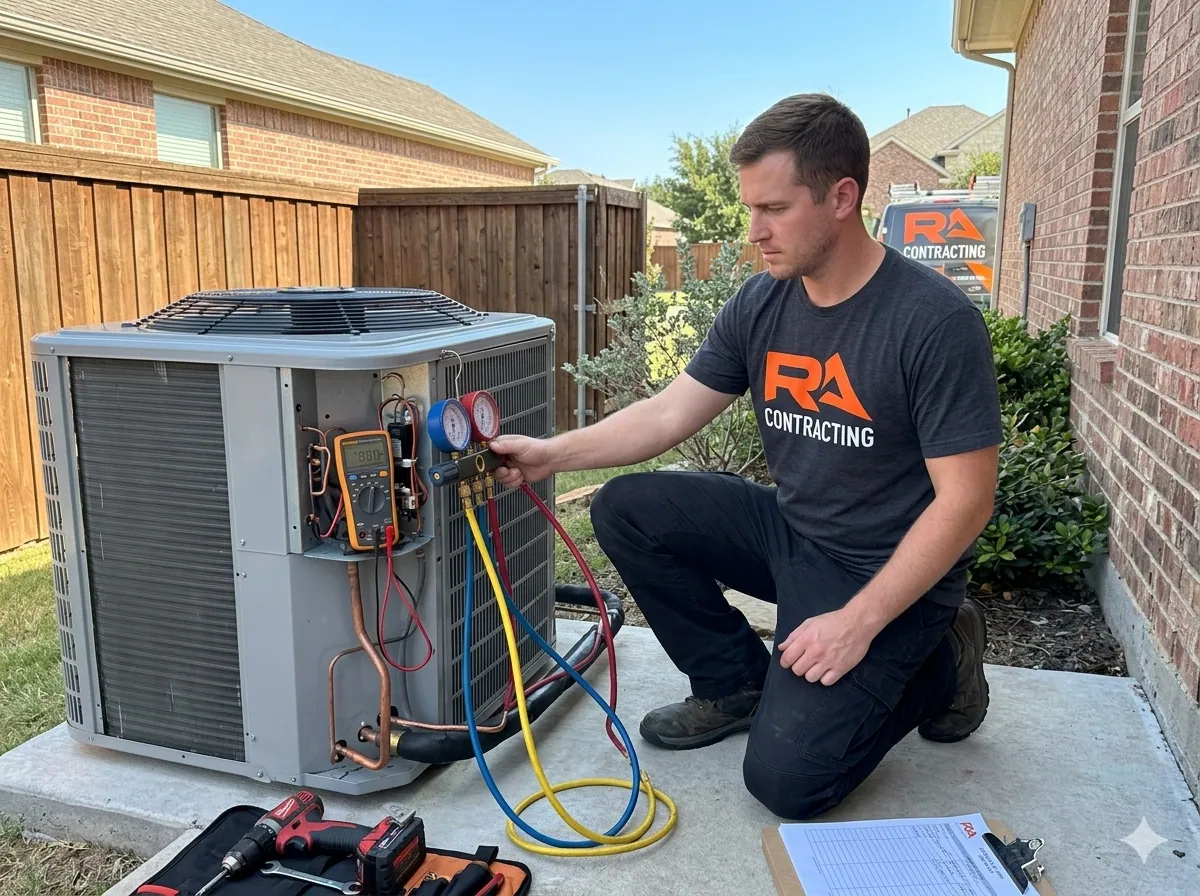
§ 06Reach the dispatch desk
One system, sized for both seasons.
A free on-site measure, transparent itemized quote, and warranty terms in writing. No upsell, no high-pressure sales. We size by the math and register the warranty the same week.
(214) 578-9961