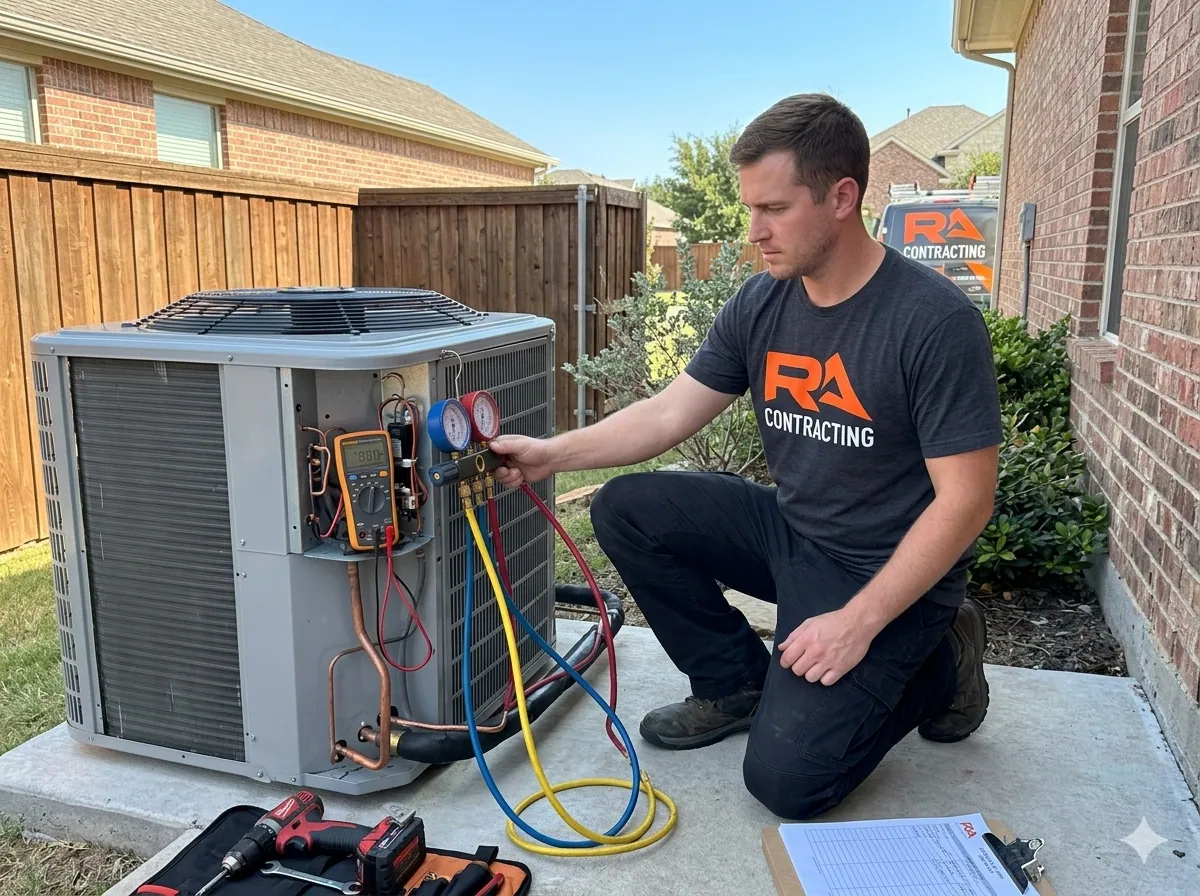
Static pressure
A magnehelic gauge reads the supply and return pressures the system fights against. High static pressure is the duct equivalent of a clogged artery — the equipment will burn out trying to push past it.
§ 02.01Ductwork + ventilation — TX + OH
Twenty minutes on site gets you a real leakage number in CFM. We will tell you whether sealing, balancing, or replacement makes the math work — before anyone writes a bid for a new unit. We won't sell you equipment when a duct fix solves it.

We arrive with calibrated instruments — not a clipboard and a hunch. Twenty minutes on site delivers four hard numbers that tell us whether the problem is the equipment, the ducts, or the way they were sized.
A magnehelic gauge reads the supply and return pressures the system fights against. High static pressure is the duct equivalent of a clogged artery — the equipment will burn out trying to push past it.
A calibrated blower pressurizes the duct system to 25 Pascals — the standard test pressure for residential ducts. The fan reports the cubic feet per minute it has to push to hold that pressure. That number is your leakage.
A flow hood at every register confirms each room is getting the airflow the load calculation says it needs. A 200 CFM bedroom that reads 90 CFM is why the master is always 8° warmer.
A neutral-buoyancy smoke pencil makes leaks visible at the joint. We photograph every problem location, mark it on a duct map, and the package goes home with you whether you sign or not.
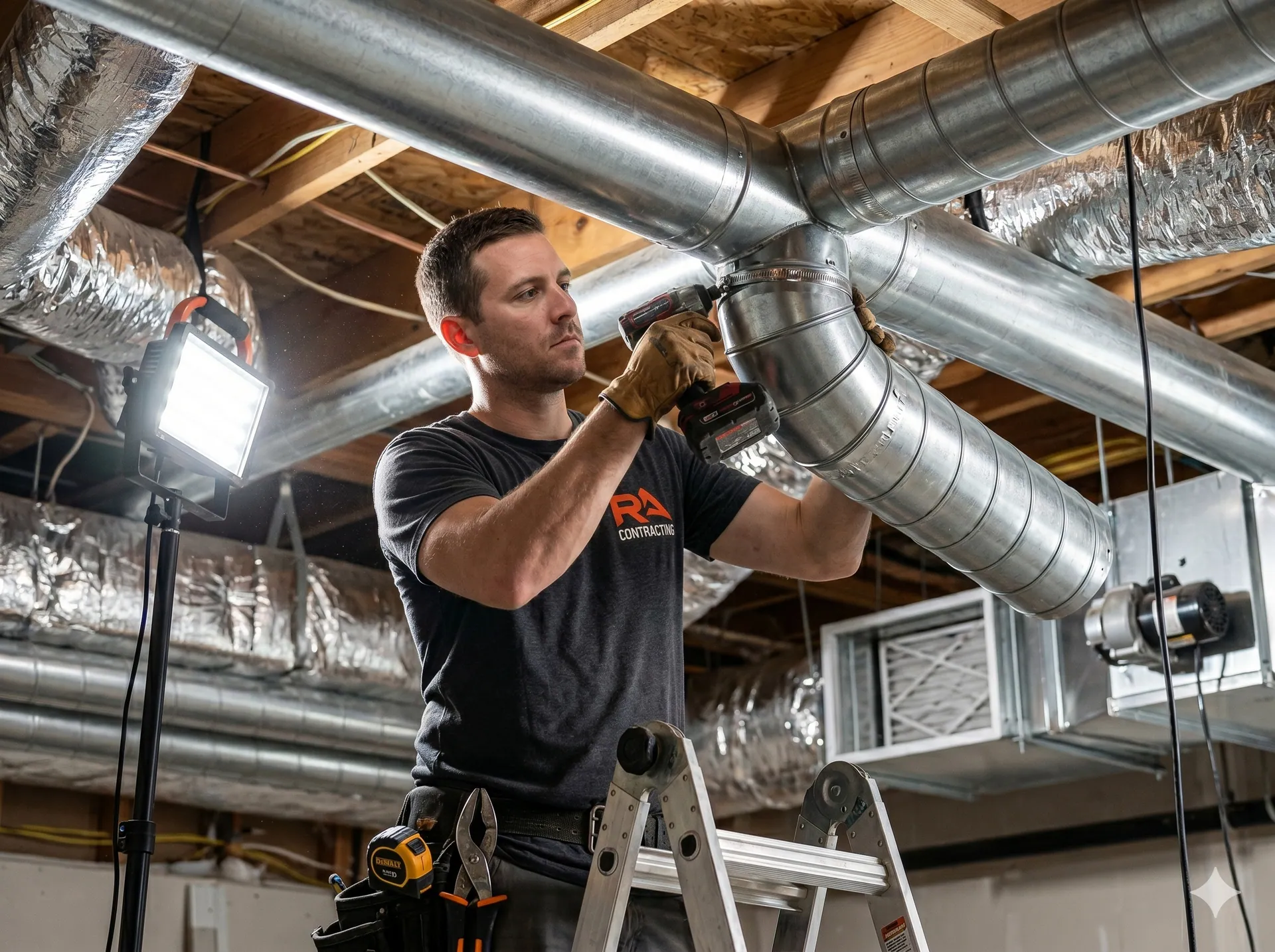
The leak rarely lives where you'd expect. Five places account for the bulk of the losses on a typical attic duct system — and they look the same in Texas as they do in Ohio. We mark every problem location on a duct map; you keep it whether you sign or not.
The cabinet seam where the air handler meets the supply trunk. Almost always loose on a 10-year-old install. First thing we tape and mastic.
The drywall cut around the register boot is rarely sealed. Conditioned air leaks into the wall cavity instead of the room. Caulk-and-mastic fix.
A zip-tied collar with no mastic over the inner liner. Loosens with every thermal cycle. Re-strap, mastic the joint, re-insulate.
A gap at the return pulls dirty attic air past the filter. The single biggest dust + allergen win on most older homes — sealed before any filter upgrade.
A flex line crushed by stored insulation, attic walkboards, or a contractor who went through later. Replace the run; sealing a kinked line is wasted mastic.
Mastic is the house standard on every job. Foil tape supplements it on rigid metal seams. Aerosol sealing comes out for the trunks we cannot reach by hand. Duct tape never leaves the truck — it only buys silence on the leak you came to fix.
The duct insulation spec changes by 4 R-values between a Texas attic and an Ohio one. Default below code is how a 20-year-old install loses 8°F to the attic on the way to the bedroom. We spec to climate, not to whatever was on the truck.
| Tier | R-value |
|---|---|
| Code minimum | R-6 |
| Our default | R-8 |
| Premium upgrade | R-10 |
A duct in a Texas attic loses cooled air to a 30°F gradient — supply air at 55°F, attic at 130°F. Below R-8, the duct itself becomes a heat exchanger and the air arriving at the register is 8–12°F warmer than what left the unit. That is the room that is "always 8° too warm."
| Tier | R-value |
|---|---|
| Code minimum | R-6 |
| Our default | R-8 |
| Cold-climate upgrade | R-12 |
In Ohio the gradient flips. Supply air at 110°F, attic at 20°F — heated air loses 90°F worth of comfort to the duct walls if the insulation is not there. Cold-climate replacements default to R-8; we step to R-12 on long trunk runs and any duct that crosses an unconditioned chase.

§ 06Reach the dispatch desk
A 20-minute pressurized duct test, a fresh load calc, and an itemized scope — seal, rebalance, or replace. You decide what gets done. The number on the test report is the number on the invoice.
(214) 578-9961